Lol !!!

Wow.

I did not see this coming.

All these years I expected the next global market crash to be governed by one of several mathematical theories that provided advance warning signs for the next potential crash. Mandelbrot’s ideas on “non-linear analysis”, “Lévy flights,” the concept of “self-organized criticality”, “random walk theory.” as well as “investor imitation” all offer their own explanations of market crashes.

None of these models could have anticipated a leader of the world’s most powerful market economy deliberately tanking global markets by foisting tariffs on the majority of exported goods produced by the majority of their long-standing trading partners and political allies.

Yet this is what President Trump decided to do on April 2, 2025—a date he referred to as America’s “Liberation Day.

It appears that American stock indexes agreed and liberated themselves from their usual market stabilizers and went into free fall (along with the rest of the international stocks).
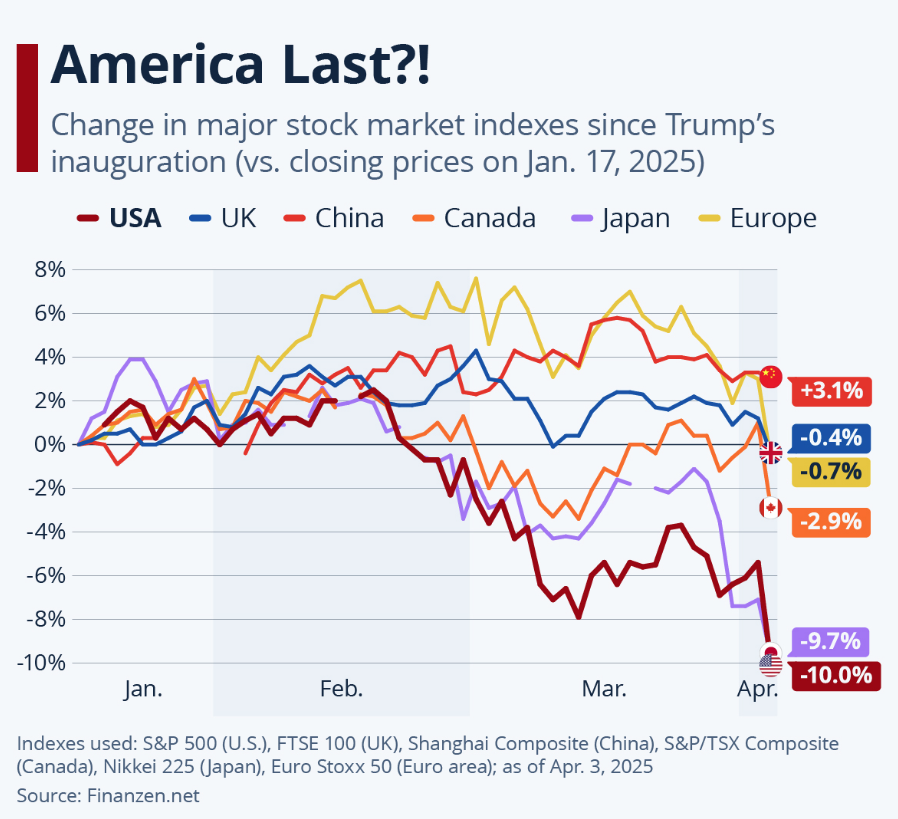
So here we are, witnessing a “market variable” that nobody anticipated: A nation’s leader deliberately throwing a wrench into the gears of a complex machine that is the world stock market.

There are critics who suggested that Trump “is purposely manipulating the stock markets …. Tariff scare, markets go down his rich buddies buy the dip, afterwards tariff off, stock market goes back up, said rich friends get richer…” Given Trump’s history of felony convictions, corrupt business practices, and grifting behavior, the suggestion that he and his allies could buy stocks at a discount before the markets bounced back would not require a great stretch of the imagination.

Of course, with every new government that comes into power, “it may decide to make new policies. Sometimes these changes can be seen as good for business, and sometimes not. They may lead to changes in inflation and interest rates, which in turn may affect stock prices.”

Is that what happened here? With Trump’s government still in its first 100 days at this point, nobody can be quite certain.

What we know for sure is that another market downturn will mean unnecessary hardship for the already stressed-out 99% of the population whose savings will plunge along with the stock prices; whose jobs hang in the balance; whose own health will need to be weighed against affording to pay rent or put food on the table; and whose kids can’t be promised a brighter future than their own.

As for the remaining 1% …?

None of the aforementioned hardship with the exception of one: The possibility of a proletarian revolution that will pit the very poor (proletariat) against the very rich (bourgeoisie).

When it came to violent class uprisings, it never ended well for the bourgeoisie.

Lol … money! The source of human misery and conflict for countless generations. /s

That’s not a laughing matter.
It’s all relative

Why do we balk at the $7 cup of latté coffee, but are willing to spend $15 on a glass of wine?

Is it because one is a daily purchase versus the other being a once-a-month treat? Having more cash to splurge during a “special night out” which justifies spending 3 times more on a similar wine serving that can be enjoyed at home?

It’s all relative, really. In other words, it’s all in our minds! Our relationship to money is so irrational, isn’t it?

Our house is on fire …

… but there’s no money to put it out.

That’s about as absurd a statement as any.

One needs water to put out a fire, not money.

Then again, one needs money to pay for the firetrucks to reach the burning building as well as for the salaries of the firemen to fight it.

If there’s no money available to afford the firetrucks or the fire fighters, then the building is a total loss.

This hypothetical scenario highlights humanity’s dysfunctional relationship with money.

We collectively watch as the building burns to the ground because we don’t have the money to afford to save it.

Humanity is doing that with our planet right now.

We are literally watching our world burn — seemingly powerless to stop it — because our nations collectively lack the money to put it out.

“Lack the money” or “lack the will to spend the money”? That’s the real question.

For centuries, the end-goal of our financial system has always been personal enrichment with no thought to the consequences of the means used to achieve that end. Where the financial system has supported technological advances, it has too often done so at the expense of polluting the planet with no thought to future consequences.

Innovations like a new source of energy in the form of crude oil, a new way to package and preserve products for consumption through the use of plastics, a new way to deliver aerosols in cans using pressurized CFCs, etc.; innovations that did not factor in the most important aspects of waste recovery and environmental pollution.

Sadly, in the minds of those who exploited these new inventions, to consider the safe recovery of waste by-products would subtract from their personal enrichment (by cutting into their profit margins), so they gave it no further attention.

Fast forward to the present, we are now reaping the poisonous harvest of those “innovations” that were meant to improve our quality of life. If only those inventors and their investors displayed some innovative thinking by anticipating the long-term consequences of their new technologies instead of leaving future generations to deal with the negative costs.

Unfortunately, this scenario has played out with many innovations that have slowly damaged our planet over multiple decades and have required tremendous investments of cash to undo the damage.

Now, imagine again, a world without money.

If money was not an issue, imagine the future technological advances we could achieve when designing products or inventing processes that had zero impact on the natural environment.

Imagine the vast amount of human creativity that would be unleashed, unfettered by special-interest groups who would want to preserve their hold on polluting technologies.

That is a future we deserve and one where we could also deal with our “burning house” without worrying about where the money would come from.

We would have access to resources to effectively deal with our multiple “fires” and not have to rely on a small group of organizations or individuals who hold the purse strings to disproportionate amounts of cash.

At the moment, the 1% hoarding the world’s wealth are fire accelerants, not decelerants.

We didn’t start the fire.” Indeed.

A global catastrophe of our own making

There are many existential threats to humanity that most people can easily call to mind: Climate change, viral pandemic, tsunamis, earthquakes, asteroid collisions, and so on.

What most surprises me is that there is one most everyone cannot recall but that we have lived with for centuries with a global impact greater than any plague. This “man-made” threat has been a silent scourge for over 90 percent of the world’s population but nothing has been done to truly remedy it.

That threat, of course, is money.

To think that our world’s nations are for the most part united in our battles against global warming and the ever-present novel coronavirus, I wonder if we could also unite to create a new system of exchange that allows humanity to fully thrive without the weight of indentured servitude hanging around our necks. Surely, if humans have the ingenuity and persistence to solve other threats to our existence, then we can find a remedy for this one.

When that happens, we would be ready to manage all other existential threats without worrying about “where the money will come from” to solve them.

An alternative “American Experiment”

As we approached it, the year 2020 seemed like one of hope and possibility before we fully understood this “novel coronavirus” and the economic crisis it would unleash.

Now here, at the other end of it, we fear what the next few years have in store for us.

Fear.

Such a powerful emotion for a such a small word.

It paralyzes the mind and immobilizes any forward progress. It divides society into tribal groups and pits “us” against “them” where reason does not stand a chance to unite them.

Sadly, we see this happening in the USA today. A once powerful nation has been brought to its knees by inside forces because it has given in to fear and loathing of its compatriots.

We have to ask: What brought the USA to the edge of this existential cliff that it now risks plummeting over?

Essentially, its love of money and free enterprise.

Historically, America was born of a revolution. Before that fateful event, it was shackled to the British Empire as one of many profitable trade colonies (supported in large part by slave labor) that fed Great Britain’s economic engine.

The United States of America began their self-declared “American Experiment” with the signing of the Declaration of Independence that saw it rise to prominence as an economic empire in its own right. It may have been founded on the ideal that all people are created equal, but in reality the continued practice of slavery contributed to its rise to economic dominance for decades after the founding of the new nation. Its pursuit of the “almighty dollar” and free enterprise would create wide gaps of inequality that persist to this day.

I have to ask: What if the great “American Experiment” had started differently?

Imagine for a moment the USA was founded on the ideals that:

“We hold these truths to be self-evident, that all people are created equal, that they are endowed by their Creator with certain unalienable Rights, that among these are Life, Liberty and the pursuit of Happiness without reliance on Money …”

What if the USA spread this message throughout the world and convinced other nations to follow?

Slavery would have been unnecessary.

Industrial innovations could have come about without any thoughts of profit or protecting intellectual property.

Cleaner and less toxic alternatives to fossil fuel could have been discovered and adopted.

Consumer products and their industrial byproducts could have been created without polluting the natural environment.

Countless wars to protect monetary dominance could have been avoided.

Economic classes would not exist.

If America was founded that way, what a different world we would be living in today.

Hindsight really is 2020.

Money and reciprocity

Feeling curious, I recently googled “money is just a construct” to see what type of dialogue I would find around that statement.

One interesting result was from the Q&A website Quora and the community’s response to a user question: “Money is above all a social construct. Can we live in a society where it doesn’t exist anymore in the future?

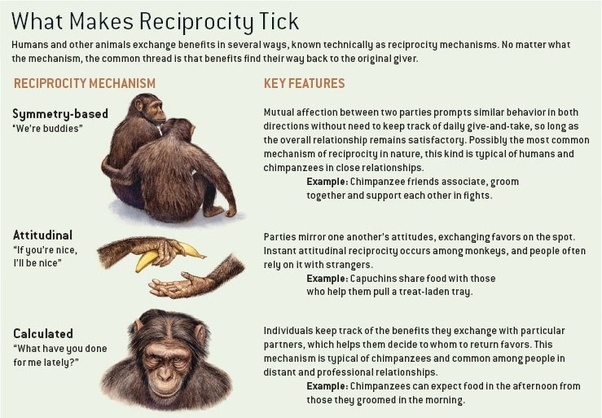
What I found most intriguing was a May 2016 response by sociologist Koyel Ranu and her discussion of “the idea of exchange, and the idea of reciprocity” where she referenced a Scientific American article that I was not aware of until I read her entry.

That article describes the concept of “behavioral economics” which views the way humans conduct business as an evolved heritage of our species and challenges classical economic theory.

HowAnimalsDoBusiness

Source:How Animals Do Business” (Scientific American, 4/2005) by F.B.M. de Waal

Interestingly, Ms Ranu also stated in her Quora response that: “Social change doesn’t come in big upheavals, unless we’re talking a revolution or a coup d’état, and even then, they are precipitated by a range of social causes. Social change comes in increments, and very small increments in that.

In case you haven’t noticed, the COVID-19 pandemic has created a period of big upheaval and that makes Humanity ripe for social change on a global scale.

However, going against our “animal nature” and giving up on reciprocity mechanisms that drive financial transactions will require incremental changes, but we must accept that the old way of transacting cannot continue. The idea that “I will give you this if you give me that” is so ingrained in our primal brains that we need to evolve beyond it and choose to say that “I will give you this because you need it and I don’t expect anything in return.”

That must be the new social construct.

Money is no object

During the COVID-19 pandemic, a New York Times article highlighted how a simple germ has thrown a microscopic wrench in the gears of the economic perpetual machine.

What perpetual machine?

That endless conveyor belt driving spending and income, consumption and production which underpins our capitalist economy. As the author states: “We buy the things we want and need, and in exchange give money to the people who produced those things, who in turn use that money to buy the things they want and need, and so on, forever.

He goes on to say: “What is so deeply worrying about the potential economic ripple effects of the virus is that it requires this perpetual motion machine to come to a near-complete stop across large chunks of the economy, for an indeterminate period of time.

Yet, interestingly, transactions for goods and services are still happening: Supply chains are still stocking our grocery stores with essential items; oil refineries are still delivering fuel to our local gas stations; manufacturing facilities are still producing (or re-tooling to produce) equipment in support of health care workers fighting the spread of COVID-19 … and ALL are doing so on the promise and belief that the economy will rebound; that the expenses incurred and sustained by these vendors, traders, retailers, suppliers, etc. will be re-paid at some point.

Right now, they are behaving as if “money is no object” otherwise they would have abandoned production long ago if they thought they were not going to be reimbursed. They realize Humanity has essential needs that must be met in spite of a crashing economy.

… and that’s the crux of the paradigm: Why does money need to remain the object?

We are at a critical point in history where we must decide that the fate of Humanity should no longer be viewed through the lens of financial economy.

As it stands, even today, one government leader has said he “would love to have the country opened up, and just raring to go, by Easter” in spite of recommendations by epidemiologists that such a move would put significantly more citizens at risk. Sadly, many of his supporters echoed his sentiments, like this Twitter user: “There will be no country left if everyone is jobless and defaults on their mortgages. I’ll take my chances with washing hands and limiting exposure to large groups, you know, normal flu precautions.

All to protect the old perpetual machine from breaking down entirely.

Maybe NOW is the time to let that happen.

The world’s nations have supply chains already in place and currently running without money truly trading hands as everyone is doing their part to prevent these chains from falling apart.

Why can’t we just consider maintaining these flows of goods and services without need for compensation? There will always be supply and demand to drive a new perpetual machine, but without money to fuel it.

Right now, the current machine is simply running on fumes.

Pandemic and money: A lethal combination

My previous post provides an unfortunate transition in light of the COVID-19 pandemic where I stated that “money is the main obstacle preventing more people from becoming doctors at a time when so many towns and cities are dealing with severe hospital staffing shortages.”

I can add that money has created a new obstacle: Access to sufficient supplies of personal protective equipment (PPE) for front-line medical personnel.

If money did not put a limit on how much PPE inventory a hospital or clinic could ideally stock, then we would not be faced with such a shortage today and putting countless people at unnecessary risk. Pie-in-the-sky thinking? No, just a logical outcome.

Also, where would we be if we managed to invest more time and effort (in a future money-free society) into antiviral research? What promising therapies could have been developed if they were not killed in today’s society because they burned through the R&D budget and there was no more money to invest? We will never know.

When the total amount of money in the world is estimated at one quadrillion US dollars, many still “nickle and dime” everything in times of a pandemic because, sadly, they are mostly thinking about economic losses rather than the loss of human lives.

Pandemics certainly put things in harsh perspective.

Primum non nocere

Primum non nocere is a Latin phrase that means “first, do no harm.” It is one of the primary bioethics rules that all medical students are taught in school.

However, after reading an article in the New York Times entitled “I Have a Ph.D. in Not Having Money“, it would seem that medical students are themselves subjected to significant financial and psychological harm by the very institution that is supposed to prepare them for a career that most want to pursue out of a desire to help their communities.

It is frustrating to read that money is the main obstacle preventing more people from becoming doctors at a time when so many towns and cities are dealing with severe medical staffing shortages.

Imagine what could be accomplished in a society that eliminated the barrier of student debt. Access to higher education would be possible to those who want to contribute to solving pressing global issues like basic health care, pollution, clean energy, malnourishment and hunger, as well as social inequality.

For now, unfortunately, money is a tremendous barrier to much-needed forward progress.

It is — right now — doing the most harm.

With apologies to the Wachowskis

I know you’re out there … I know that you’re afraid … You’re afraid of change.

I don’t know the future. I didn’t come here to tell you how this is going to end. I came here to tell you how it’s going to begin.

I’m going to show you what the rich don’t want you to see.

I’m going to show you a world without money, a world without debt and debtors prison, without limitations or boundaries, a world where anything is possible.

Where we go from there is a choice I leave to you.

(inspired by “The Matrix“, 1999)